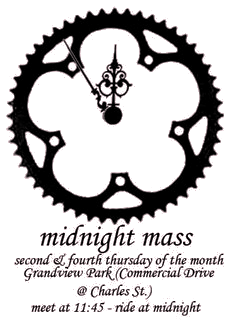
Prayer for cars.
if you'd rather pray for bikes...biketemple.org
Labels: bike church, car cult, killer cars
Vancouver Critical Mass
Mostly event announcements, news, and bicycle related activist opinions...
Download Critical Mass flyers and posters, or upload your own
Email vancouvercm~AT~gmail~DOT~com for a posting password
Yes, we ride the last Friday of every month!
Labels: bike church, car cult, killer cars
Labels: activism, car cult, collective action, safety
AUBURN HILLS, MI—In a press event at its corporate headquarters Tuesday, Big Three automaker Chrysler unveiled a new entry into its vehicle lineup known as the Reside, a midsized, five-passenger sedan designed exclusively for in-home driving.

According to Chrysler chairman C. Robert Kidder, who kicked off the event by driving a sporty red test model from his office to the showroom podium, the household automobile has been "expertly engineered" for indoor driving conditions and is "ideal" for people on the go from one room of their home to another.
"With its sport-tuned suspension and spacious, comfortable interior, the Reside provides the ultimate around-the-house driving experience," said Kidder, gesturing toward a large image behind him of the vehicle cornering smoothly around an ottoman. "It's perfect for hauling that big load of laundry, shuttling the kids off to bed, and bringing the whole family to the dinner table each night."
"But this isn't your typical ho-hum four-door sedan," Kidder added. "It's also a high-performance vehicle that's great for just hitting the open halls or cruising down to the basement rec room to get away from it all."
Following years of flagging sales, billions in government aid, and a Chapter 11 bankruptcy reorganization, Chrysler hopes to reverse its fortunes by positioning itself as the first mover in the untapped within-home transportation market, which it regards as a vast and lucrative growth sector.

If you are concerned about cycling throughout the Lower Mainland please join the VACC. Go to http://www.vacc.bc.ca/ for details.
Listserv Disclaimer:
Messages and opinions expressed on this listserv are those of the author and are not necessarily the opinions of the VACC, its officers or members.
The VACC reserves the right to terminate the listserv or any individual member's subscription to the list at any time if warranted.
Your email settings: Individual Email|Traditional
Change settings via the Web (Yahoo! ID required)
Change settings via email: Switch delivery to Daily Digest | Switch to Fully Featured
Visit Your Group | Yahoo! Groups Terms of Use | Unsubscribe
__,_._,___
Labels: car cult, killer cars, nazis, video
| www.StopThePave.org >> |
| Calling all residents, students, parents, elders, streamkeepers, treeplanters, guerilla gardeners, blockaders, rebels, climate defenders, farmers and freeway fighters! |
![]() |
| As chainsaws roar and bulldozers get set to roll on the controversial $2 billion South Fraser Perimeter Road freeway (SFPR), join local residents and community groups to stand up for climate justice! |
| Last October, hundreds of people dug up the freeway construction site in Surrey with shovels and wheelbarrows, and in December we used sand from the SFPR to build a dike blocking the provincial cabinet offices. Now it's time to step up the campaign of mass direct action against climate crime. We need to turn up the heat, in order to turn down the heat. |
| WHAT & WHEN: Mass Direct Action against Climate Crime, beginning at 2 pm on Friday April 22 (Mother Earth Day). Actions may continue over multiple days on this long weekend and beyond. Like our previous actions, it will be non-disruptive to area residents, even as we disrupt continuation of the South Fraser Perimeter Road freeway (SFPR). There will be a variety of ways people can get involved and demonstrate their support, including roles with little or no legal risk. All are welcome to participate. |
| WHERE: Meet at Annieville Supermarket, 10996 River Road, Delta. (Take the 640 bus from Scott Road Skytrain or Ladner Exchange) |
| Come to a pre-action Teach-in! Join us for presentations, action planning, skill sharing and legal info: |
|
| WHO: This is an initiative of climate justice activists from GatewaySucks.org, local Council of Canadians chapters, the Critical Criminology Working Group and others. We welcome your involvement in the planning process, especially at a teach-in before the action (see above). We seek endorsements and input from other organizations, and your help in mobilizing your friends, neighbours, community groups or affinity group to join us! |
| WHY: Now under legal challenge in federal court, the estimated $2 billion proposed SFPR freeway would greatly increase greenhouse gas emissions, pave invaluable farmland, scar the banks of the Fraser River, pollute elementary school playgrounds, and damage indigenous heritage sites. This freeway is an irresponsible waste of public money, and many similar projects have been stopped before. The SFPR has already been "downgraded" due to lack of funds, and dubbed a "white elephant" in the mainstream press. We will emphasize the need to shift resources from climate crimes like freeways to public transit, and to protect communities from flooding and other effects of global warming. |
| CONTACT: Send endorsements and questions to info@stopthepave.org or call 604,877,1223, and visit us at www.StopThePave.org |
| Let's kick off a hot summer of resistance! |
| www.StopThePave.org >> (formerly GatewaySucks.org) |
| |
Labels: activism, car cult, direct action, gateway
Labels: bike lanes, car cult, city, politics, trick

Labels: car cult, direct action

Hi Ron:
Thanks for sending this around.
There are two other reports like this that I have seen. One is from ToddLitman at the VTPI, the other is from the BC Provincial Gov't (Department of Transportation and Infrastructure).
Their conclusions are pretty much congruent between the three of them.
Bye, Ken Ohrn
Labels: car cult
Labels: car cult, carfree, europe, fun, funny, porsche, satire
theglobeandmail.com article about CM:
Last updated on Thursday, Aug. 06, 2009 10:28PM EDT
What is it with Vancouver? Mere days after the local media and citizenry worked themselves into a ludicrous lather over the closing of a single lane on the Burrard Bridge, oops, they did it again.
This time, hysteria levels were raised to a fever pitch about the Critical Mass bike ride destined to bring civilization as we know it to an end last Friday, with several thousand cyclists refusing to stop at red lights and being purposefully vague about where they were going. The horror, the horror.
These monthly rides to celebrate biking have been taking place for a while, but this time, for some reason, everyone seemed to go a little nuts. Police begged for advance notice of the route, radio hotlines burned with rage, city councillors urged calm, and the media prepared once more for chaos – choppers and breathless reporters at the ready.
Of course, the rides are a pain in the butt for downtown drivers trying to get somewhere on a busy Friday night. The previous Critical Mass produced an actual altercation. But no worry. Riders were told how to handle angry motorists.
“Stopping to ogle seems to escalate the problem by focusing on the conflict. Breathe deeply,” a Critical Mass pamphlet suggested, adding helpfully, “It is harder for people to be angry when we are having so much fun. …” True, that. You want to put a smile on the face of a Hummer driver? Just send thousands of cheery cyclists past him when he's trying to get to the bar.
Similarly, for those brave souls standing in the way of cars at intersections: “You can wave at the bikers going by, and entertain the drivers who are waiting.” How about sawing a cyclist in half?
At any rate, the pedal-pushers rode all over the city, and, as with the predicted Burrard Bridge brouhaha, nothing happened.
Still, Vancouver Police spokeswoman Constable Jana McGuinness kept us all up to date with rapid-fire reports, as if O.J. Simpson were headed down the highway in a white Bronco.
10:24 “The ride appears to be heading towards the Lions Gate Bridge, as they are now in Stanley Park Drive.”
10:35 “Riders appear to have abandoned the plan to head over the Lions Gate Bridge and are now headed back into the downtown core along Robson Street.”
10:51 “Riders are once again heading along the Stanley Park causeway towards the Lions Gate Bridge.”
11:38 “The riders are now crossing the Burrard Bridge and may be heading towards Kits Beach.”
11:50 “The ride has concluded near Kits Beach and participants are breaking off on their own now.”
11:52 “Why am I here?” (Just kidding about that one…)
The city slept soundly.


Let’s state the obvious: a street or a highway is completely useless if you don’t have wheels on which to ride over it. As an installation of public investment, a network of roads is only a half-done job. The point of all the shared public expense in this massive installation is to enable citizens and cargo to move around. Its construction has come at incalculable cost. Just consider the value of land alone that is taken up with streets. Add in the thousands of dollars for every stop sign, parking sign and safety sign, the hundreds of thousands of dollars for every set of traffic lights, the tens of millions for all the street lights and the hundred or so million for the water run-off system under the streets. Consider the annual costs of painting lines, rebuilding curbs, removing snow and street cleaning. Throw in the enormous costs of policing traffic, the court system, the price for a rapid response emergency crash system complete with fire trucks and ambulances no more than minutes away from anywhere, and add on the hospital costs of all those injured in the everyday operation of the road system.

All of that, and still, the job is incomplete because the whole massive installation, surely amounting to billions for Vancouver alone, is utterly useless as it stands. One still needs to have some means of conveyance to give the whole enormously expensive system any value at all.
It is the running of buses through the road system that completes the picture, that finally finishes the job and gives the public any value out of the whole works. As a proportion of the total that’s been invested already and the ongoing maintenance and service costs, adding buses amounts to probably less than 1% more when everything from fire trucks to hospitals to police and snow removal are considered. Without buses, it’s as though someone built 99 feet of a 100 foot bridge and can’t find the will to build that final foot that finally makes the whole bridge worthwhile. A network of bus routes and a sufficient number of buses running through it is not an add-on that can be considered or rejected, it is the sine qua non that delivers to the investors—the public—the value promised in all the funds collected from them over the decades. A public road system without a public means to put it to use is like a fine expensive bicycle without any wheels. Nice so far, but useless.
Of course, a lot of people have cars, and so the road system is rendered useful to them. The final 1% of the job that makes all the difference between an expensive public system useful to the public that built it and a completely useless waste of billions is to be supplied by private individual investors. It’s the equivalent of building at great public expense a massive health care system and then restricting access exclusively to those able to pay an expensive private access fee. But because the buses were the final part of the whole public road installation and because we’ve gone on so long thinking of buses as an add-on to an otherwise complete job, nobody anymore thinks of buses as essential to the concept of the public transportation system. One need only recall that the road system was installed first and then everybody had to buy private cars to use it, to appreciate the enormity of the betrayal. It wasn’t as though everyone already had a car and demanded the construction of roads to use them on.
It is in this context through which reports of Translink’s funding shortfalls should be viewed. Translink is the public agency responsible for the roads and the provision of buses to be used upon them. Once the roads were built, the provision of an appropriate level of bus service has perennially been a bone of contention. The final 1% of the total cost of a public transportation investment—that mere 1%—has been the downfall of the whole idea. Now there are proposals to reduce bus service, cancel routes, shorten the service day and massively increase fares, all because the bus provision part of the system is said to lose money. Never mind that the street light part of the system “loses” a lot more money, as does the street sign part, the land-owning part, the water run-off part, the ambulance part, the hospital part, the snow removal part and so on.
Why is there no talk of removing traffic lights if money is tight? These do nothing but lose money also. The roads themselves should just as whimsically be considered for ripping up, the land beneath them sold, so much do roads do nothing but lose money. But only the bus portion of the system is scrutinized for its costs, and is expected to generate revenue to cover those costs. Drivers of cars are outraged they will be asked to pay tolls to cross the newly reconstructed Port Mann Bridge—cost: $3 billion—even though bus riders have been paying far more in tolls to use the public roads everyday since forever.
We’re promised by the provincial government that bus service across the new Port Mann Bridge could someday in the future be added, as though the bridge will have delivered its public value in total even without the provision of a bus service across it. Even if a resident of Langley got the global climate message and wanted to make an effort to change and stop using a carbon-burning car, the lack of the final part of the system—wheels with which to roll over the terrifically expensive road system between Vancouver and Langley—they could not do so. The bus part was left off the agenda in the end, like a roof being left off a palace, rendering it useless.
It is in this view absurd that the public must now agitate for buses to make the whole road system they already built finally of value to them. It is a moral outrage that what buses exist require an exorbitant toll for every use of them. It is unethical in the extreme for bureaucrats and political leaders alike to portray the bus service as an extra add-on to a road system, subjected to its own separate accounting, when no other part of the system is so separately scrutinized. And it is reprehensible for any public official to dare suggest any measure that reduces already deplorable bus service with the environmental cost of the private car alternative so severe, so obvious and so broadly understood.
Everyone should be able to ride without a toll over the entire regional road network since we already all paid for it. It’s a nasty trick to deliver 99% of the deal and withhold for ransom the important final 1% of the hardware. Imagine being sold a car and then finding out the wheels are extra. That’s the insult the public has been slapped with for decades. Only in defeat and exasperation, not to mention at great additional personal expense, have those with the means given up and bought a car.
No public official should escape profound shame for suggesting tolls for buses are fair, let alone that they should be raised, and for suggesting yet more public investment in infrastructure like roads and bridges without considering their primary purpose of delivering the wheels with which to make them of any value to the public.
Every time you want to travel the roads and there is no bus for you, you are profoundly betrayed, and every time you are made to pay to board the bus is the ransom of a hostage captured and roasted alive by their very own government. Buses are the road system; it is the cars that are the extra add-on.
Labels: bus, car cult, public space, republic, taxes
Labels: capitalism, car cult, government, oil
While all eyes were fixed on the banking bail-out, a bucketload of public money was quietly sloshed into the pockets of another undeserving cause. Last week, George Bush agreed to lend $25bn to US car manufacturers. It's a soft loan, which will cost the government $7.5bn. Few people noticed; fewer fought it. The House of Representatives approved the measure by 370 votes to 58. The great corporate bail-out is spreading like the plague.
It has already crossed the Atlantic. Yesterday European car makers demanded that the EU hand them €40bn ($54bn) in cheap loans to match the US subsidy. Where will the public spending spree end?
The motor companies in both Europe and the US claim they need these loans to help them go green. They will invest the money in a new generation of environmental technologies, which will allow them to meet the efficiency standards their governments are setting. There is more joy in heaven over one sinner who repents ... but how strange this green enthusiasm seems, now that there's the smell of public money in the air. For the past 10 years the car manufacturers have driven every useful green initiative into the wall.
In 1998 European car makers promised to show that they could cut their greenhouse gases voluntarily. By the end of 2008, they pledged, they would reduce the average emissions produced by their cars from 190 grams of carbon dioxide per kilometre to 140. How well have they done? By the end of last year they had cut average pollution to 158g/km across Europe and 165g/km in the UK: they will miss their target by some 40%.
Discerning, only 10 years too late, that lobby groups' promises are worth as much as a share in Lehman Brothers, in 2006 the European commission announced that it would set compulsory standards: by 2012 all manufacturers would have to reduce their average CO2 emissions to 120g/km. It looked like progress, until you remembered that 120g was the target proposed by the EU in 1994, to be met by 2005. It was repeatedly delayed by industry lobbying.
Last year the 2012 target fell to the same forces. Angela Merkel, lobbying on behalf of companies such as DaimlerChrysler and BMW, demanded that the European commission put the brakes on. (Ironically it was Merkel, as the idealistic young German environment minister, who had first proposed the target of 120g/km by 2005.) The commission agreed to revise the figure to 130g, and to cover the gap by raising the contribution from biofuels. Since then we've seen hard evidence that most biofuels, as well as spreading starvation, produce more greenhouse gases than petrol; but the policy remains unchanged.
Now the pollutocrats are whingeing that they can't meet the 130g target either. A month ago they persuaded the European parliament's industry committee to take up their case: it proposed postponing the target until 2015, reducing the fines if they don't comply, and allowing manufacturers to offset eco-innovations against the target even if these don't actually reduce emissions. These invertebrates, in other words, proposed to grant official approval to industry greenwash. Fortunately this scam was rejected two weeks ago by the parliament's environment committee.
In the US, manufacturers have still not reached the standard (an average of 27.5 miles per gallon) that they were supposed to have met, under the Energy Policy Conservation Act, by 1985. The average car sold in the States today is less efficient than the 1908 Model T Ford.
What makes this dithering so frustrating is that to be talking, in 2008, about targets of 130 or 120g/km is a bit like discussing whether modern computers should have 10 rows of sliding beads or 100. In 1974 a stripped-down 1959 Opel T-1 managed 377 miles to the US gallon (160km/l), which equates to 15 grams of CO2 per kilometre. There is no technical reason why the maximum limit for mass-produced cars shouldn't be 50g/km.
Nor is there a good commercial reason. A poll by the Newspaper Marketing Agency shows that 80% of car buyers say economy is now more important to them than performance. The car industry's technological failure results entirely from lobbying by the companies now demanding public money to go green. They want to squeeze every last drop from existing technologies before switching to better models.
Their sabotage of green technology has been both subtle and comprehensive. The film Who Killed The Electric Car? shows how the manufacturers, working with oil companies and corrupt officials, sank California's attempt to change vehicle technologies. Having bumped off battery power, they persuaded the federal government to pour money instead into hydrogen vehicles, aware that the technological hurdles are so high that a cheap, mass-produced model might never be possible. Electric cars, by contrast, have been ready for the mass market for almost a century. The $1.2bn that the US government is spending on research and development for hydrogen cars - like the €2bn pledged to the same quest by the European Union - is a subsidy for avoiding technological change.
Now, after so much procrastination, the car makers have the flaming cheek to demand public money to pursue the policies they have spent 50 years and millions of dollars crushing. Of course, the "green loans" they are soliciting are nothing of the kind. Funding better environmental performance is simply an excuse for bailing out another failing industry. As a result of the credit crunch and high oil prices, new car registrations in the UK fell by 21% last month. In the US, sales by the major manufacturers have declined this year by between 20 and 35%.
There is no need to spend a penny of public money on greening the motor industry. As a recent report by the House of Commons environmental audit committee shows, you could achieve the same outcome by creating a bigger differential between vehicle tax bands: it proposes that people buying the least efficient cars should pay around £2,000 more per year than those buying the most efficient. This would kill the market for gas guzzlers and force the industry to make the changes it has long resisted.
But the government has taken all the flak a good tax policy would have generated for very little gain. Its controversial new vehicle tax banding will save a mere 0.16 million tonnes of CO2 per year: a drop in the acidifying ocean. At scarcely greater political cost it could have hammered emissions and generated much of the money it needs to revolutionise public transport. Again there has been a great historical slide: between 1920 and 1948 cars were taxed at £1 per horsepower: in real terms (and in some cases in nominal terms) a far higher rate for gas guzzlers than today's.
But subsidies are what governments pay when regulation doesn't happen. If you don't have the guts to force companies to do something, you must bribe them instead. It's a fair guess that European car makers will still fail to meet their environmental targets, even if they get the money they're demanding. The greenest thing governments could do is to allow these foot-dragging, planet-eating spongers to go under.
Labels: car cult, government
See, like I always say... It's always about cars... The centre of our economy and the primary dominant infrastructure - the real grid. Cars don't do what they say (move you efficiently) but they are great status symbols.
Like most punditry, this article is simplistic. The days of consumer debt identity screw the house car driving are far from over. And the impact is not clear. But, I still think this sums up a few important ideas well.
---
RICHARD FLORIDA October 4, 2008 Globe & Mail
Most experts agree this is the worst financial meltdown since the Great Depression. The stock market is down almost 25 percent so far this year. Housing prices in the United States are off more than 20 per cent since their peak in 2006. Manufacturing output is falling and consumer confidence has slipped.
Martin Feldstein, former head of the National Bureau of Economic Research, past chairman of the Council of Economic Advisers and a Harvard economics professor - usually a voice of calming reassurance - wrote in The Wall Street Journal: “Sliding into recession, monetary policy already at maximum easing, and fiscal transfers impotent … an unenviable situation, to say the least, for any incoming president.”
All of this raises two fundamental questions: Where did this financial mess come from? And what does it mean?
The easy answer is to blame the housing market. People took out adjustable-rate mortgages and subprime loans offered with no down payment and easy terms by mortgage brokers who then resold them as securities. As the housing market has weakened and loans have reset, a growing number cannot repay and many more owe more on their mortgages than their homes are worth. Banks and financial institutions, so the story goes, are clogged with this bad debt, now dubbed toxic waste. This is the kind of thinking behind the U.S. financial bailout: Remove the toxicity and all will magically be well again.
The real reason is that the roots of the current crisis are tied to the fundamental nature of the postwar model of economic development called “Fordism.” That model drew a tight connection between assembly-line mass production and mass consumption - ultimately fueled by massive suburbanization.
After introducing the assembly line and making car production more efficient and cars cheaper, Henry Ford realized that a bigger market for his cars was needed - so he boosted workers’ wages by introducing the “five-dollar day.” But even that was not enough, and so North America and the world lapsed into the Great Depression.
Fordism emerged as a full-blown economic and social model during the 1930s, marked by president Franklin D. Roosevelt’s New Deal programs, and flourished after the Second World War, when government policies brought about the rise of longer-term mortgages and a new system organized under the now infamous Fannie Mae to purchase those mortgages and thus lubricate the system.
Add to that massive tax breaks for homeownership and gargantuan subsidies for highway construction and infrastructure, and a whole new model of suburban-fueled mass consumption was born - family after family purchased new homes, filling them with TVs, appliances and all manner of furnishings, while also purchasing record numbers of cars to get to and from work.
While Fordism looks stable on the surface, it suffers from a fatal flaw: It’s impossible for consumption to keep up with the ever-growing pace and efficiency of production. This is particularly true of recent times, when a great deal of production has been sent to China, India and other places where labour is cheaper. It’s hard for the working and middle classes to consume more when their wages are essentially stagnant. Low-wage workers in emerging economies do not have the income to fill the gap. And while the ranks of the rich have grown, the wealthy are a relatively small group that can buy only so many luxury cars, designer products, homes and yachts.
That’s where credit comes in. Those new fancy mortgage instruments were meant to turn homes into veritable “piggy banks” that could be used to finance bigger and better cars and homes and toys.
Almost a century ago, Austrian economist Rudolf Hilferding identified this basic contradiction of modern capitalism in his monumental work Finance Capital. Capitalist economic development stands on a shaky foundation, he argued - workers always produce more than they can consume, more even than society as a whole can consume.
As one leading blogger, Yves Smith at Naked Capitalism, recently put it: “Since consumption has come to depend on growth in indebtedness, a reversal, however painful, is necessary. Our excesses have been so great that there is no way out of this that does not lead to a general fall in living standards.”
There you have it. The financial crisis is in reality a much deeper crisis of our underlying economic model and our way of life. It’s a crisis of the way we have come to define ourselves.
If Fordist mass consumption had a catchphrase, it was “Keeping up with the Joneses” - and in the past decade it became a fearsome standard. So many of us came to define ourselves not through our work or creative endeavors, but through what we could purchase. We were fooled into believing that our identity and self-worth somehow depended on acquiring expensive or impressive belongings - much of it on credit.
Regardless of how or when the financial markets are restored, credit will be much harder to get - the age of the house as piggy bank is long gone.
How will we define ourselves when we can’t get a quick self-defining “makeover” at the dealership, the electronics store or the mall? How will we rebuild our way of life and our very identity? Those are the questions that many of us, and our society as a whole, will be confronting long after the financial markets have been restored.
---
Here is a major secret hint in how to live off of less to those hit hard by this economic downturn: Stop driving! Cars are extremely expensive and most of the costs to the owner are hidden (insurance, maintenance, fuel, ill-health) such that even with the high purchase price you don't know what you are getting into. The social costs (and subsidy) is even higher. Anyway, you will save a lot, have more time, and be able to do more (health, adventure, etc.) - if you drive less (ie don't own a car but maybe share one). This secret could solve widespread social problems if we all as a society changed direction, had lots of new jobs, worked on the environment as is needed, got more deeply local... But that wishful thinking is "backwards" thinking to too many people for it to be our chosen policy. Ah well, nature will force us -eventually- if we don't choose it.
~rusl
Labels: capitalism, car cult