Vancouver Critical Mass

Mostly event announcements, news, and bicycle related activist opinions...
Download Critical Mass flyers and posters, or upload your own
Email vancouvercm~AT~gmail~DOT~com for a posting password
Yes, we ride the last Friday of every month!

9.9.08

Most trips into downtown core don't include car

Really interesting story buried on page B7. Not exactly overnight news but probably of more long term social importance than just about any other story. Cars are our religion.

What would really be interesting is to pair this information with a count of lanes/space allocated to getting downtown. One could use Google Earth and some public statistics that could probably found online. We would count the road width and then measure the proportion of that devoted to car-only (or car mostly) lanes, vs bike lanes, bus lanes sidewalk. Of course we'd have to count the seabus and skytrain... Not sure how to weight those. Ideally by number of people moved somehow. The long and the short of it would be then to juxtapose the high numbers of people shunning cars to get downtown and the low number of space devoted to transporting said masses. Pretty simple argument and irrefutable. Could be really compelling if done in a graphical way that is quick to read. Maybe someone with funding for this sort of education might want to take this on such as BEST and make it really slick. Could be a great tool for this upcoming municipal election.
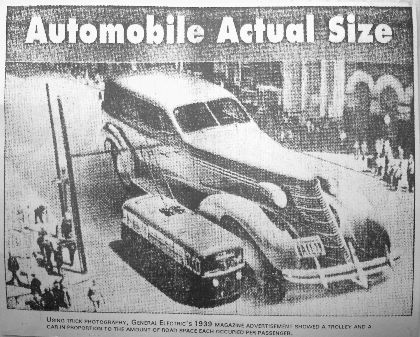
 from BIKECULT: Using Trick Photography, General Electric's 1939 Magazine Advertisment Showed a Trolley and a Car in Proportion to the Amount of Road Space Each Occupied Per Passenger.

It's finally time to turn over a new leaf and walk at least part of the way to work.

You can drive part of the way and walk the rest or combine walking and transit. You will burn calories. You will not pollute. You will feel a bit smug.

And this month there will be thousands like you -- burned by high gas prices, frustrated by traffic congestion, given the finger once too often - tramping to work in the morning mist.

Evidence is ample that the revolution has already come to the City of Vancouver. Most trips in the downtown area (60 per cent) include walking or a combination of transit, cycling or walking. City-wide the figure is about 37 per cent. Outside Vancouver proper the news is not as good. Only 18 per cent of trips include walking, cycling or transit and only four per cent of commutes are by foot alone.

The growth of regional town centres, which combine commercial and high-density residential development, in Surrey, the Coquitlams, Burnaby and Maple Ridge should improve that figure as people begin to live and work in the same neighbourhood.

But if you live in the low-density suburban sprawl that characterizes much of Metro Vancouver there is a good chance you are using your car for nearly every trip you make. Hey, it's quick it's easy and the car is sitting right there in the driveway.

Changing your ways will not be easy.

If you are living a fast-paced, tightly scheduled, highly programmed family life with kids and work and you want to walk more you will have to do less.

If you want to leave smaller environmental footprints, start by getting the kids to school without your car.

Crosby, Stills and Nash suggested that you Teach your children well. You had better try setting a good example, because Lord knows they don't listen.

The B.C. Automobile Association is urging parents to stop driving their kids to school, especially if they live within a few blocks. If it really is too far for the little tykes to walk -- unlikely -- drop your kids a few blocks from school and let them hoof it.

"They will burn a few calories before they get to school and it will be much safer around the school for all the kids," said David Dunne, a spokesman for the BCAA traffic safety foundation.

Ironically, parents driving children to school are the biggest safety threat to school-aged children and all the traffic and idling just ensures that all the children will be breathing in exhaust fumes right before heading to class.

"The congestion around schools poses a tremendous risk to those kids who are trying to get to school in a more responsible way," he said.

Most schools have no parking and no stopping zones around school grounds to deter parents who insist on picking up and dropping off as close to the front door as possibly. Administrators who try to stop parents from ignoring the rules often face anger and abuse, Dunne said.

"There's an element of stranger danger for sure driving these parents' behaviour," said Dunne.

If you are a nervous type, walk with your kids. Better yet, get your kids organized with neighbourhood friends to walk to school together.

"Really what drives a lot of it is convenience," he said. "It's just easier to throw the kids in the car, drop them off and get on with your day."


Car convenience is such an unshakable myth. It comes from the fact that by driving you are working with "the system" instead of against it.... Ah well, a whole other topic entirely!

~rusl

Labels: , ,

27.8.08

Food for Thought

A Wiki for the Planet: Clay Shirky on Open Source Environmentalism

By Alexis Madrigal August 20, 2008 | 6:00:00 AM

Clay Shirky is a leading thinker about how the internet is changing the world. In his writing, especially the recent book, herecomeseverybody.org he detailed how the networked world allows people to form leaderless groups that still do useful work.

Through illuminating examples like his calculation that herecomeseverybody.org/...looking-for-the-mouse Wikipedia was created in about the same amount of time that Americans spend watching commercials each weekend, Shirky argues that humans in the post-industrial age are just coming to terms with how to spend their "cognitive surplus."

We talked with him about how that surplus might be directed at tackling global environmental degradation. Shirky focused on the need for new legal and social structures -- working through online media -- to enable collective action.

Along the way, he touched on Facebook's limitations, why conserving oil might not actually help the world, and why Linux programmers and Critical Mass cyclists might be the new models for political action.

Wired.com: Can you talk about how social applications could help solve environmental problems?
Clay Shirky: There is no larger collective-action problem than the environment. The three biggest lies of the environmental movement is that every little bit helps, you can do your part, and together we can do it. [Compact fluorescent lightbulbs] are nice, but people going down and changing CFLs in a handful of fixtures isn't going to cut it.

It's a collective-action problem. The difference between what all the people can do individually and the global consumption of nonrenewable resources is huge. The tension is … what will it take to get people to act in concert? There isn't any additive solution to the problem. It will be both governmental and social because that's the scale of the problem.

Wired.com: Have you seen any social applications online that begin to
approach that scale?
Shirky: No, not yet. This is something I discovered as a result of doing the book. There are lots and lots of examples of large-scale sustained work in the world of IP. Linux and Wikipedia. These are large-scale, long-term efforts. But in the domain of collective action, it's almost all short-term and almost all protest-oriented.

There's a couple of reasons for that. Collective action is considerably harder to arrange than simple collaboration. It's a strange to say that something like Wikipedia is simple, but compared to large-scale collective action problems, it is.

The other big change is that there would have to be some structure for recognizing the groups taking the action. There are examples from intellectual property. The GNU public license, creative commons license, etc. … These are ways of carving out the rights that participants have. It seems to me that one of the things that's missing on a collective action front is the ability for people to come together in a way that is similar
to Linux and Wikipedia, but has specific, targeted policy goals.

Issue-oriented nonprofits, e.g. The Sierra Club, need to be involving more participants, but that seems to require new legal structure, not just a bunch of people trying to do the right thing. If that was all it took, Wikipedia would have happened 10 years before it did. It takes people who want to do the right thing and the structure to
make that happen.

Wired.com: What sort of online tools would enable that kind of collaboration? What's missing?
Shirky: What's missing is there's no license. There's no equivalent of the GPL [www.gnu.org/copyleft/gpl GNU General Public License].
There's been some tools for collaborative production of thinking. Anything from mailing lists to Wikis. What we don't have is tools for acting once a decision has been taken. In Linux the final action is the compile step. In Wikipedia the action is the latest edit.

Now we need to turn around and do X out in the world. I don't think that there's anything digital that we could do that would solve this gap. I think the gap is produced by the difficulty of translating thought into action. I think the kind of things that help people turn thoughts into action are much more about social and legal structures.

What is the significant long-term policy we need to put in place to start replacing fossil fuel energy sources? That's not a Facebook app in Facebook's current incarnation.

The way I'm asking myself the question is: who is the current Richard Stallman [founder of the fsf.org Free Software Foundation]
… Is there someone working on the problem of translating thought into action in a way that all members of the group can agree on? This is the incredible thing about Linux. Even when individual coders find decisions not to their liking, it's still better to stick around with Linux as it is. The legitimacy that Linux has acquired has kept the group together. Who's out there that's thinking about the structural difficulties of turning thought into action? I know it's not me. I wish it was. It may be nyls.edu/pages/2726 David Johnson at New York Law School [creator of dotank.nyls.edu Do Tank, Democracy Design Workshop].

Whoever gets that right is going to be providing the key thing that's missing right now.

Wired.com: When you talk about collective action, it sounds like you're talking about local government. Maybe it's not true in national government where each individual's contribution to the decision-making process approaches zero, but you can change policy at the county or city level.

Shirky: You can have some sustained impact on local policy. A group worth modeling is critical-mass.org Critical Mass, who have essentially said that there is absolutely no reason the streets have to be owned by cars. We'll demonstrate that by owning the streets for one day.

The NYPD is furious about these guys and they came out recently and -- they so don't understand what's going on -- they said, "We're willing to sit down with these guys and make a deal. We're willing to sit down with their leader …"

Wired.com: And co-opt them.
Shirky: Exactly, but they won't tell us who their leader is. Critical Mass has a structure where that kind of negotiation is off the table. Who the police deptartment is bargaining with is the populace, the bike-riding populace. That is the kind of thing that is possible.

Wired.com: What do you think about organizing efforts like Bill McKibben's 350.org?
Shirky: I sort of reflexively dislike McKibben. He wrote a book with a section about the value of a duck swimming around a pond and contrasting that with the vast wasteland of television. But he made a whole point of not telling people about where it was. It's private property. He owns it and he's able to go there. Any solution that doesn't work for cities doesn't work. McKibben's natural splendor argument is so unfit for the 21st
century. That said, I haven't seen 350. Maybe his thinking has changed.

Wired.com: What about currently existing apps that allow resource sharing or the like to push down demand? Could they have an impact? Like, say, something like the
new.facebook Carpool app?
Shirky: Obviously this is the type of thing where lots and lots of different efforts add up to something. Certainly the social networking services have a role. For those sorts of point-to-point matching, social networks are quite good. There are a lot of effects there where if you take a group of people that just needs a coordination layer, to come together and do something, the Facebooks of the world are great.

Here's the problem: Lowering demand alone tends to lower the price, and lowering the price lowers it for everybody. Everything that reduces an individual's purchase on the fuel network ends up subsidizing businesses' use of the same fuel.

You can conserve aluminum. You can see that the can goes into recycling. But if you don't use oil, that oil is available to use. Then the cost comes down so demand rises again. As useful as carpooling might be in the short-term … anything that only reduces demand is subsidizing price. Carpooling is important for urban density, air pollution and other reasons but carpooling is not the kind of thing that actually changes the energy equation.

Wired.com: But what about a world in which the supply of energy is limited?
Shirky: The www.theoildrum.com Peak Oil argument .… If the factors driving the price of oil up are much more tied to supply than demand, which isn't this year, and probably not in five years, but maybe in 10 years, we'll be carpooling as a kind of crisis response. But the effect of carpooling will be to lengthen the crisis of oil .… The longer we can use oil as efficiently as we do, the longer it postpones the search for
alternatives.

WiSci 2.0: Alexis Madrigal

Wired Science on

Labels: , ,

14.2.08

share, don't steal.

Labels: